
Is QA Engineering Dying in the AI Era? Let’s Look at the Data

When I created this Substack, my goal was simple: to share my knowledge about software testing and reach you directly. I know I haven’t published much recently, but my goal is to pick it up again and keep publishing frequently, because I truly believe it can create great value in addition to my Udemy courses.
The first topic I want to discuss is QA engineering in the AI era. This topic gives me constant thoughts and, to be honest, sometimes even anxiety when I see how quickly things are changing. Every time I open LinkedIn or Twitter, I see countless buzzwords about how software engineering is dead or how we are one year away from replacing all white-collar jobs. I believe these titles are designed to scare people and make them panic. So far, it has been a successful strategy, and many people are afraid of generative AI. But we are engineers. We need to see real data about these changes before we believe them.
Recently, I did some research on how the QA job market has evolved over the past few years. Let’s have a look at the data together and decide whether our profession is truly a dead end, or whether it is simply evolving like everything else in the world.
I’ll be honest: I used Claude AI to collect some numbers and information. As I always say in my courses, AI is a tool to enhance our capabilities. I also use it in my day-to-day work so I can spend more time on the things that matter most. At first, I started writing this article focusing on the EU QA market. When I prompted Claude to fetch some data, it gave me the following table:
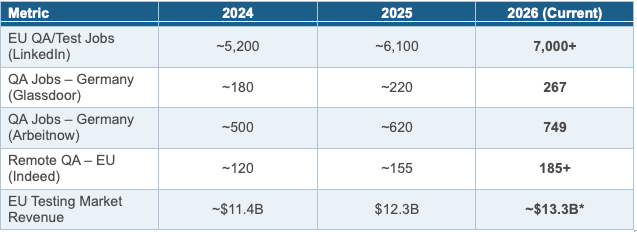
At first, I thought: hmm, this looks good. But then I asked myself: what are the actual sources for the 2024 and 2025 data? The answer was exactly what I expected.
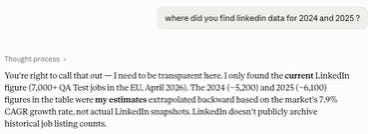
So, It was not real data! It was only an estimate — in other words, a guess generated by AI.
Even this small example perfectly explains the reality of AI today. We need to review and cross-check all information before using it. Otherwise, it can hallucinate and generate unrealistic data.
After this, I tried to dig deeper and find more reliable information about the European QA job market, but unfortunately, detailed data was not easily available. Instead, I decided to use global QA market data:

By checking multiple data points, we can clearly see that the global software testing market is growing year by year.
Compared to 55.8B in 2024, it grew to 60.0B in 2025 and, so far, to 64.3B in 2026. Over the last two years, growth has been around 15%. This means more opportunities for us.
When we look at data like this, we can see that the fear created around AI is, so far, not realistic. In many cases, it feels more like a marketing strategy. Don’t get me wrong, I personally use AI, and I am updating all my Udemy courses to introduce AI tools into software testing processes. It is a great tool for us to learn, use, and make our lives easier.
My personal opinion is that AI will solve some QA and testing challenges that currently take a lot of time. This gives us more time to focus on the real problem: the quality of the software we produce. I believe it will accelerate the shift-left approach even further. QA engineers should be part of every discussion from the very beginning of requirement gathering. At that stage, we can already use our critical thinking skills to help clarify customer expectations. Writing clear test scenarios or acceptance criteria early can easily be transformed into test cases and automation scenarios with generative AI. But as I mentioned, complexity begins during the refinement phase, and QA is needed now more than ever in software companies.
Also, if we think about end-to-end software delivery, QA will be still needed at every stage of the software life cycle. From refinement to final regression checks, our role becomes even more important. AI helps us create software faster and easier (in some use cases), but it also creates a lot of sloppy code, which introduces problems and different challanges. Because of this, QA engineers need to learn new technologies and adapt to the current way software is delivered.
I like to keep my articles short, since it’s not easy to read loong articles with a lot of information (personally I can’t so I believe it’s nicer to share short thoughts on topics)
In the next article, I will focus on some AI testing capabilities that are especially useful for QA engineers. See you next time.
Ozan
References:
https://www.gminsights.com/industry-analysis/software-testing-market
https://www.capgemini.com/insights/research-library/world-quality-report-2025-26/